
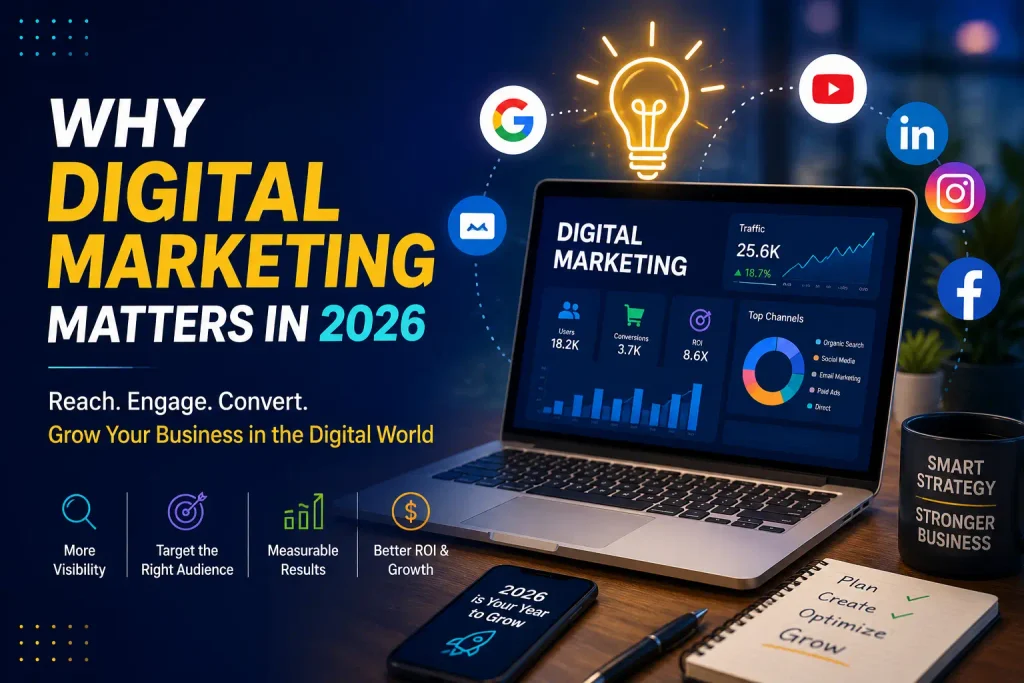
The importance of digital marketing is easy to state and easy to underestimate: if customers can’t find you online, they will find someone else. Before buying almost anything, people search, compare options, read reviews, and check social media, often on their phones and often within minutes.
This guide gives nine practical reasons digital marketing matters for business growth in 2026, with examples for small and local businesses and a section on what it means in Dubai and the UAE. For a comparison with offline channels, see my guide to digital marketing vs traditional marketing.
Quick summary: Digital marketing matters because it puts you where customers already look, lets you start with a small budget, shows you exactly what works, and builds assets such as search rankings and email lists that keep paying off.
1. Customers Start Their Search Online
Buyers now do their homework before they ever contact a business. They search, compare options, read reviews, and ask questions on social media. If your business doesn’t appear at those steps, you simply aren’t part of the decision.
That is the core value of digital marketing: being visible at the moment someone is actively looking. A quick test is to search for your own service plus your city and see what a customer sees. If you aren’t there, or if a competitor is, you’ve found your first opportunity.
2. It Reaches the Right People Without a Huge Budget
Television, radio, and print usually need large budgets and reach plenty of people who will never buy. Digital channels work differently. Google Ads and social ads let you choose location, interests, and search intent, and you can start with a small daily spend and increase it only when something works.
Because of this, small and mid-sized businesses can compete with much bigger brands. Attention is won by relevance as much as by budget.
3. Data Replaces Guesswork
Online, you can see how people found your site, which pages they read, and which ads or posts led to an enquiry. Tools like Google Analytics 4 and your ad platform’s reports turn marketing from a hopeful expense into something you can measure.
This matters more than it sounds. Many businesses skip tracking and then can’t tell which spend is working, which is one reason they end up wasting money on marketing. A simple monthly review of enquiries per channel fixes most of that.
4. Search Visibility Works Like a Shop Front
People who search for a service are often ready to act, and the businesses at the top of the results get most of the clicks. Search engine optimization (SEO) improves your chances by strengthening your content, site structure, page speed, and credibility.
Google increasingly rewards pages that show real experience and trust, so original examples and honest detail count for more than generic text. SEO is slower than ads, but its results last. When you stop paying for ads, the traffic stops. A page that ranks well can keep bringing enquiries for months.
5. Social Media Builds Familiarity and Trust
Social platforms are where many people first meet a brand. Instagram, LinkedIn, YouTube, and TikTok each suit different audiences, so choose the ones where your customers actually spend time instead of trying to be everywhere.
Unlike a billboard, social media allows a conversation. Replying to comments, answering questions, and sharing real customer stories make a business feel approachable, and familiarity is often what tips a buyer toward you.
6. Email Gives You an Audience You Own
Social reach can rise or fall with every algorithm change. An email list is different: these are people who chose to hear from you, and nobody can switch off your access to them.
Email works well for nurturing leads, announcing offers, and bringing past customers back. Segmenting your list by interest or past purchases keeps messages relevant, and for many businesses it is one of the most cost-effective channels available.
7. Content Makes Every Channel Work Harder
Helpful articles, videos, and case studies answer the questions customers are already asking. Good content can rank in search, feed your social channels, and give your emails something worth reading.
The best content comes from real experience: how you solve a problem, what results clients saw, what mistakes to avoid. That kind of detail builds trust faster than general advice, and it is hard for competitors to copy.
8. AI and Automation Save Time, but Strategy Still Wins
AI tools can help draft content, analyze data, suggest ad variations, and personalize emails. Used well, they free up time for the work that matters most.
However, AI doesn’t know your customers, your market, or what makes your offer different. Generic AI-written content tends to blend in with everyone else’s. Use AI to speed up the routine tasks, and keep the positioning, the offer, and the final decisions in human hands.
9. Local Businesses Gain the Most
Many people assume digital marketing is for large companies, but local businesses often see some of the quickest and clearest results. Customers search for “near me” services every day, whether they need a restaurant, a clinic, a gym, or a tradesperson.
Local search optimization, a complete Google Business Profile, customer reviews, and location-targeted ads all help you appear when nearby customers are looking. Strong visibility in your own area makes you the obvious choice before a competitor gets a chance.
The Importance of Digital Marketing in Dubai and the UAE
Dubai is a fast-moving, international market with many competitors in nearly every category. Customers often compare options on Google, check Instagram, and then send a WhatsApp message before they ever fill in a form. Businesses that answer quickly and show up at each of those steps win more enquiries.
It also helps to think about language, since many customers read Arabic, English, or both. Tracking phone calls and WhatsApp clicks, not only website visits, shows what your marketing is really producing. A digital marketing freelancer in Dubai can help you build that picture across the whole customer journey.
Where to Start: A Simple 4-Step Plan
- Fix the basics. Make sure your website loads quickly on a phone, explains your offer clearly, and makes it easy to get in touch.
- Claim your local presence. Set up your Google Business Profile if you’re eligible, and start collecting genuine reviews.
- Pick one or two channels. Choose where your customers actually are, and stick with them for 90 days before judging results.
- Track enquiries, not just clicks. Review calls, forms, and WhatsApp messages monthly, and move your budget toward what works.
Frequently Asked Questions
It lets small businesses compete for attention without a large budget. You can start small, target the right people, see exactly what works, and put more money behind it as results come in.
Yes, as long as it is tied to clear goals and tracked properly. Without a plan or measurement, money can drain away on any channel.
It depends on how your customers buy. Service businesses often start with SEO and Google Ads, because people search when they need help. Visual and consumer brands often start with Instagram or YouTube. Add email as soon as you have contacts to nurture.
Paid ads can produce enquiries within days or weeks. SEO and content usually take a few months to build momentum, but they tend to get more cost-effective over time.
Final Thoughts
The importance of digital marketing comes down to this: your customers are already searching, comparing, and deciding online, and your business needs to be part of that process. You don’t need to do everything at once. Start with a solid website, pick the channels that fit your customers, and measure what happens.
Want help working out where to begin? Send me a message, and I’ll review your current online presence and suggest the first steps. Get a free strategy call on WhatsApp
Pingback: Why Businesses Waste Money on Marketing (and How to Fix It)
Pingback: Creative Digital Marketing vs Traditional Digital Marketing: What Actually Works in 2026? - Digital Marketer Expert in Dubai