
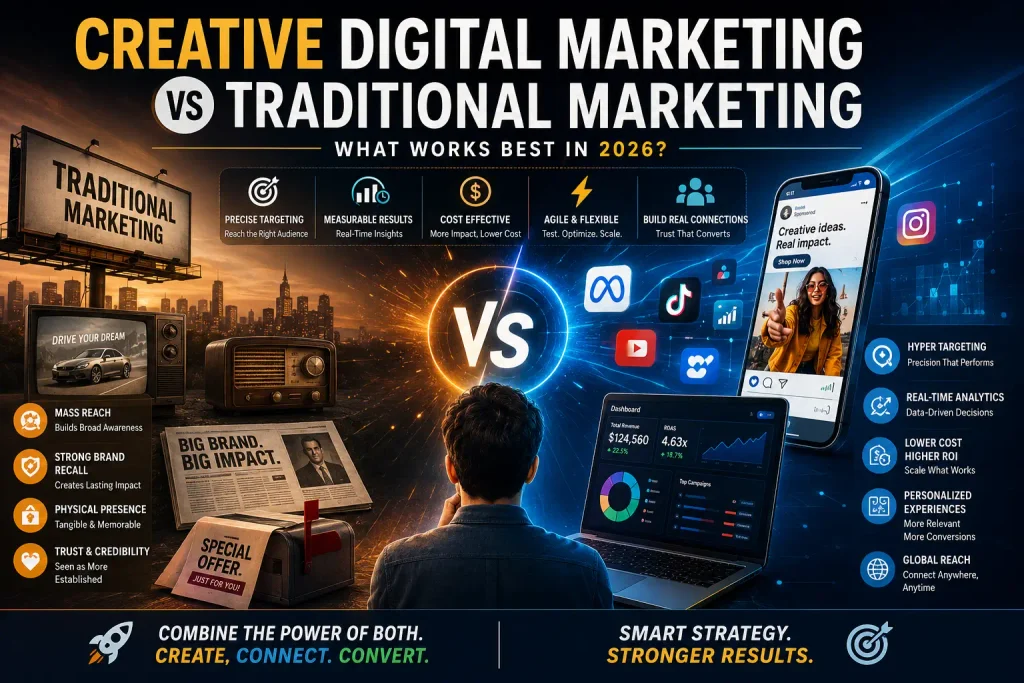
Let me be straight with you: I’ve had this conversation more times than I can count. A business owner pulls me aside and asks, “Should I run Facebook ads or stick to billboards? Should I invest in creative digital campaigns or keep doing what’s always worked?”
And here’s the honest answer it’s the wrong question.
Both can work, but treating it as an either-or choice is where the thinking goes wrong. The debate over digital marketing vs traditional marketing hides a better one: which approach earns attention, builds trust, and brings in customers for your business today?
The short answer: Digital marketing usually wins on cost control, targeting, and measurement. Traditional marketing wins on local trust and mass awareness. Most businesses get the best results by combining both, with strong creative holding everything together.
In this guide, I compare the two across five factors, explain why creative quality now outweighs targeting, show how to measure it, and look at what it means for businesses in Dubai and the UAE. For the bigger picture, see my overview of digital marketing in 2026.
What Is Digital Marketing, and What Is Traditional Marketing?
Digital marketing is any promotion that happens through internet-connected channels: search engines, social media, email, websites, video platforms, and apps.
Traditional marketing covers everything that reaches people offline, such as television and radio spots, printed ads, outdoor signage, mailers, and sponsored events. It long predates the internet and remains effective for many businesses.
Creative digital marketing is digital marketing led by strong ideas. It uses storytelling, design, emotion, and originality to make people stop scrolling and act. A dull ad on the right platform will still lose to a sharp idea.
Digital Marketing vs Traditional Marketing: A Head-to-Head Comparison
Here is the comparison at a glance:
| Factor | Digital marketing | Traditional marketing |
|---|---|---|
| Upfront cost | Low entry cost, and spend can grow as results come in | High, production and media are paid in advance |
| Targeting | By location, interests, job title, search intent | By area, publication, or time slot |
| Measurement | Close to real time, down to the single ad | Indirect: surveys, coupon codes, sales changes |
| Speed of change | Hours | Weeks |
| Trust and feel | Built through content and proof | Strong local familiarity and physical presence |
| Best for | Leads, sales, retargeting, testing | Local awareness, credibility, big moments |
Here is what each row means in practice.
a. Cost and budget flexibility
Traditional channels ask for money upfront: a billboard lease, a print run, a radio slot. You pay before you know whether the message works. Digital marketing lets you start small, watch the results, and move money toward what performs. If one ad is clearly producing leads, you can put more behind it the same day.
b. Targeting versus mass reach
A billboard or TV spot reaches everyone who passes or tunes in, and most of them are not your customers. Digital ads can target by location, interests, job title, or search intent. Traditional media still has an edge in shared moments, though. A prominent billboard or a well-placed feature makes a brand feel established.
c. Measurement
With traditional marketing, you know the ad ran, and you can estimate its impact through coupon codes, surveys, or sales changes weeks later. With digital marketing, you can see which headline, image, or video hook performed best. That detail is what makes steady improvement possible.
d. Speed of execution
A print or outdoor campaign can take weeks to design, produce, and place, and it is hard to change once it is live. A digital ad can launch tomorrow and be edited the day after, so you learn faster and waste less..
e. Trust and emotional connection
This is where traditional marketing still holds its own. A printed brochure, a familiar local sign, or a trusted radio voice feels personal in a way a banner ad often doesn’t. As more online content looks machine-made, that human feel becomes more valuable. The strongest digital campaigns borrow it by using real faces, real customers, and local detail.
Why Creative Quality Now Matters More Than Targeting
Years ago, digital success depended on clever audience targeting. Today, privacy changes have limited tracking, and ad platforms increasingly decide automatically who sees your ad. You set the goal, and the platform finds the audience.
That shifts the weight onto the ad itself. The hook, the visual, the story, and the offer now decide whether people stop and whether the platform keeps showing it. In practice, your creative does much of the targeting work.
AI tools have also made it easy for anyone to produce passable content. Because of this, standing out takes something specific: a real customer story, a clear promise, or a detail only your business could include.
A few habits help:
- Watch for creative fatigue. Even your best ad wears out, so plan fresh variations before performance drops.
- Lead with a problem or an emotion in the first seconds of a video or the first line of copy.
- Use real people and real results wherever possible, since authentic content tends to earn more trust than polished stock imagery.
- Make it local. Regional language, places, and culture show viewers the ad is meant for them.
How to Measure Creative Performance
Good measurement turns creative work into a skill you can improve. Start by tracking four things: how many viewers stay past the opening seconds of a video, click-through rate, cost per lead or sale, and how quickly each ad’s results decline.
These tools can help:
- Google Analytics 4: the free foundation for seeing what visitors do after they click.
- Meta Ads Manager and Google Ads reports: built in, and enough for most small businesses to compare ads.
- Motion: a creative analytics tool for paid social that groups ads by hook, format, and style so you can spot winning patterns.
- Triple Whale: useful for online stores that want to connect ad creative to sales.
You don’t need all of them. Begin with GA4 and your ad platform’s reports, and add a paid tool only when your ad spend justifies it.
Digital vs Traditional Marketing in Dubai and the UAE
Dubai is a market where both still work, which makes the mix matter even more. People here often move between Google, Instagram, and WhatsApp before they enquire, and they also see billboards, mall screens, and print every day. Many customers speak more than one language, so the choice of Arabic, English, or both deserves real thought.
A practical approach is to use outdoor or event presence to build recognition, then use digital ads and search to capture the people who go looking for you afterwards. Tracking WhatsApp clicks and phone calls shows you which side is doing the work.
If you want help building that mix, a digital marketing freelancer in Dubai can look at your whole funnel instead of a single channel.
Which Approach Is Right for Your Business?
- Local shop or restaurant: Start with Google Business and Instagram ads, then add local signage or flyers for walk-in traffic.
- B2B service company: Lead with SEO, LinkedIn, and Google Ads, and use events and networking to build credibility.
- New brand with a small budget: Go digital first, learn from the data, and add offline channels once you know your message works.
- Established brand: Keep traditional channels for awareness, and use digital to measure and retarget.
If your campaigns aren’t paying off in any of these cases, you may be wasting money on marketing for reasons that have nothing to do with the channel.
Frequently Asked Questions
Yes, for the right goals. It is strong for local awareness, credibility, and reaching people who rarely click on ads. It is weaker on measurement, so pair it with something trackable, such as a unique phone number, QR code, or offer code.
It usually needs less money to start and is easier to scale up or stop. However, it is not automatically cheaper. Poorly targeted or weak ads waste budget on any channel.
Yes. Start with the channel that reaches your best customers most directly, measure the results, and then add the second channel to reinforce it.
Final Thoughts
The argument over digital marketing vs traditional marketing is mostly a distraction. Both can build trust and bring in customers, and neither does it automatically. What separates strong results from weak ones is the quality of the creative and how carefully you measure it.
Pick one thing to do this week: review the ad you’ve been running the longest, check whether you can see its results, and decide what to test next.
Not sure which mix fits your business? Send me a message, and I’ll review your current marketing and recommend where to start. Get a free strategy call on WhatsApp
Pingback: Why Businesses Waste Money on Marketing (and How to Fix It)
Pingback: Importance of Digital Marketing in 2026: 9 Key Reasons