
Let me be straight with you: I’ve had this conversation more times than I can count. A business owner pulls me aside and asks, “Should I run Facebook ads or stick to billboards? Should I invest in creative digital campaigns or keep doing what’s always worked?”
And here’s the honest answer it’s the wrong question.
The real question is: which approach earns attention, builds trust, and converts in today’s environment? And the answer to that is more nuanced than anyone’s click-bait headline will tell you.
In this article, I’m going to break down creative digital marketing vs traditional digital marketing what each one actually is, where each one wins, what the data says in 2026, the best tools to measure your creative performance, and how to stop guessing and start making decisions with clarity.
Whether you’re a startup founder, a marketing manager, or a freelancer pitching clients, what you’re about to read will change how you think about your next campaign.
What Is Digital Marketing and What Makes It “Creative”?
Let’s get the basics right first, because I see a lot of confusion here.
Digital marketing is any promotional activity that happens through internet-connected channels search engines, social media, email, websites, YouTube, apps. That’s the umbrella.
Creative digital marketing is what separates the brands that win from the ones that disappear into the noise. It’s not just being online it’s using storytelling, design, emotion, and originality to make people stop scrolling, feel something, and take action. Think of it as the art inside the science of digital.
Traditional marketing, on the other hand, is the stuff that predates the internet TV commercials, radio spots, print ads, billboards, direct mail, and event sponsorships. It’s offline. It’s been around for decades and still commands serious respect.
Here’s the thing most people miss: both have evolved dramatically. Traditional isn’t dead. Digital isn’t automatically better. But the creative element how you tell your story, what emotions you trigger, what visuals you use that is now the single biggest performance lever in paid media, according to research I’ll show you shortly.
Creative Digital Marketing vs Traditional Digital Marketing: A Head-to-Head Reality Check
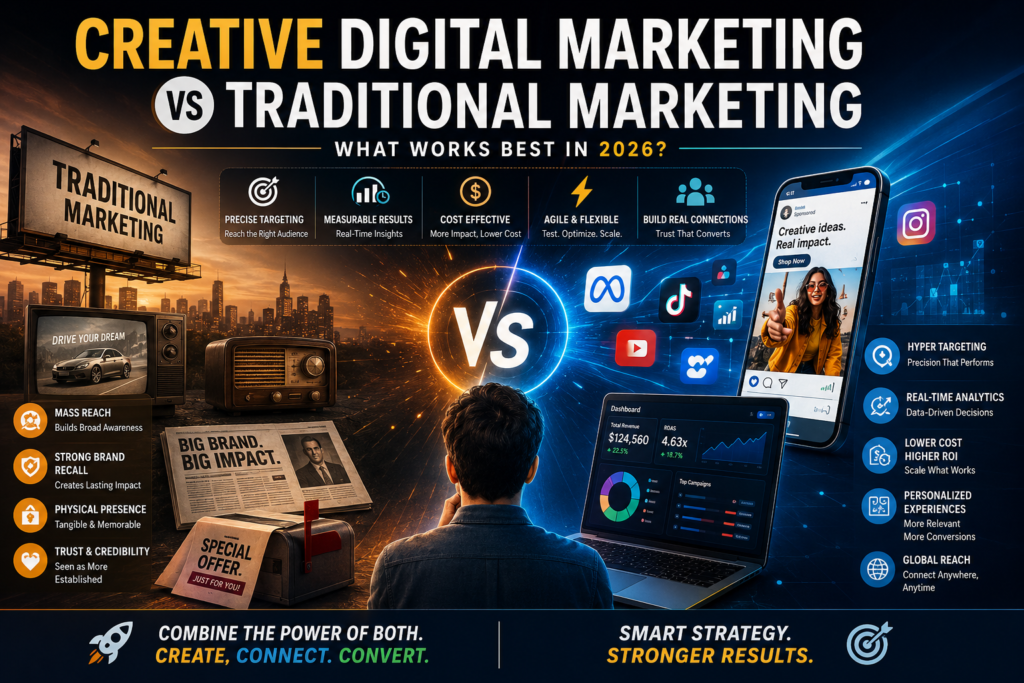
Let me walk you through the five dimensions that actually matter when comparing these two approaches.
1. Cost and Budget Flexibility
Traditional marketing hits you with large, upfront costs. A TV commercial slot, a billboard lease, a magazine spread you’re paying before you know if it works. And if the offer is wrong, the message misses, or the timing is off? You’ve already spent the money.
Digital marketing flips this on its head. You can start with a small daily budget, run a creative ad, watch what happens in real time, and put more money behind only what’s working. If Tuesday is a dead day for your audience, pause the campaign. If a specific creative asset is driving a 4x return, scale it immediately.
This flexibility is why, according to research, digital advertising now represents about 74% of global ad spend. The control it gives marketers is simply too valuable to ignore.
2. Targeting Precision vs Mass Reach
Traditional marketing is interruptive by design. A TV ad reaches thousands or millions of viewers, but most of them aren’t your customer. You’re paying to reach everyone hoping to find the few.
Creative digital advertising lets you target based on age, location, interests, job title, search intent, and even past behavior on your website. You’re putting your message in front of the exact people most likely to care.
That said, traditional marketing has something digital often can’t replicate: shared cultural moments. A Super Bowl ad, a billboard on a high-traffic road, a newspaper front-page feature these create mass awareness and a sense of social proof that can be remarkably powerful for brand building.
3. Measurability and Creative Insights
Here’s where digital marketing wins decisively, and specifically where creative digital marketing has become its own discipline.
In traditional marketing, you know the ad ran. You might get some sales lift data weeks later. But you genuinely don’t know which element of the ad worked the headline? The colors? The call to action?
In digital, you know everything. Which headline got more clicks. Which video hook held attention past the 3-second mark. Which color combination drove more purchases. This is what the industry now calls creative analytics and it’s reshaping how marketing professionals work.
I’ll get into the best tools for this shortly, but understand this: creative-level insights are now considered the most valuable data a performance marketer can access. Research shows that creative-level performance differences far outweigh audience targeting differences in paid social. Your creative quality is now doing the job that targeting used to do.
4. Speed of Execution
If you want to run a print ad, you’re looking at design, printing, distribution, and lead times that can stretch weeks or months. If you need to change the message mid-campaign because something isn’t working, you’re largely stuck.
With digital, you can build a creative ad today, launch it tomorrow, and have real performance data by the end of the week. If the messaging isn’t landing, you iterate. If one version outperforms another, you scale the winner. This agility is one of the defining advantages of creative digital marketing in 2026.
5. Trust and Emotional Connection
This is the one area where traditional marketing still punches above its weight and smart digital marketers are learning from it.
Physical mail feels personal in a way that an inbox notification doesn’t. A well-placed billboard in a community builds local familiarity. A radio host’s endorsement carries warmth that a banner ad simply can’t replicate.
Here’s the irony: in 2026, as AI floods the internet with generic content, audiences are craving exactly what traditional marketing was built on human connection, authenticity, and sensory experience. Adobe’s 2026 Creative Trends Report confirms this: people want content that feels real, that they can almost touch and hear, content grounded in local culture and genuine emotion.
The brands winning right now are the ones bringing that traditional emotional depth into their digital creative. That’s the convergence that most articles miss.
The Rise of Creative Digital Advertising: Why Your Creative IS Your Targeting
Let me spend a moment here because I think this is the insight most marketers even experienced ones haven’t fully internalized yet.
A few years ago, you could win on digital by being smart about who you targeted. Detailed audience segmentation, lookalike audiences, third-party cookie tracking the game was about finding the right person.
That game is over.
With iOS privacy changes, the death of third-party cookies, and platforms shifting toward broad algorithmic delivery, targeting advantages have shrunk dramatically. Platforms like Meta now rely more on AI-driven distribution. You tell the algorithm your goal, and it figures out who to show your ad to.
This means the burden of performance has shifted entirely onto creative quality. Your ad’s hook, visual, story, and offer that’s what signals to the algorithm AND to the human viewer that your content is worth amplifying.
In short: your creative IS your targeting.
Nearly 40% of video ads are projected to involve generative AI by 2026. This means the baseline for “decent looking” has dropped to zero. Everyone can produce competent content. The only way to stand out is through genuinely compelling creative emotion, story, specificity, humanity.
This is why creative digital marketing, done with strategic intent, is outperforming traditional approaches in measurable ROI and why smart brands are investing heavily in creative analytics to understand what’s working and why.
Creative Insights for Digital Marketing Professionals: What the Data Is Telling Us
I want to give you some specific intelligence here, not vague platitudes.
Here’s what the market data says about creative performance heading into 2026:
Emotional resonance is commercially valuable. Nearly 50% of customers say they’re more likely to buy from brands that make them feel joy. This isn’t soft marketing theory it’s a purchase driver. If your digital creative isn’t designed to trigger a specific emotion, it’s leaving money on the table.
User-generated content outperforms branded content. 93% of marketers report that UGC performs better than brand-produced content because of the trust factor. Authenticity isn’t a trend it’s a conversion mechanism.
Gen Z is craving local and real. In a world saturated with AI-generated polish, younger audiences are drawn to what’s local, specific, and culturally grounded. “Think global reach with a local voice” is how Adobe’s creative team puts it. Your regional specificity is a competitive advantage, not a limitation.
Creative fatigue is real and trackable. Your best-performing ad will eventually stop working. The brands that scale this correctly track creative saturation early and rotate fresh variations before performance tanks.
Best Creative Analytics Tools for Digital Marketing in 2026
If you’re serious about creative digital marketing, you need to stop flying blind. Here are the tools professionals are actually using to understand what makes their ads work.
Motion (Best for Dedicated Creative Intelligence)
Motion leads the pack for creative analytics. It automatically tags your ad elements hooks, formats, personas, visual styles then analyzes performance patterns across your entire creative library. If you run paid social at any real scale, Motion helps you stop guessing and start briefing winning creatives by design.
Benly (Best AI-Powered Creative Analysis)
Benly uses AI to automatically identify winning patterns in your ad creative and answer questions in natural language. Ask it “why did this ad outperform last week?” and get an actual answer. It’s built for teams who want creative intelligence without becoming data analysts.
Triple Whale (Best for DTC and E-commerce Brands)
If you’re running a Shopify-based business, Triple Whale is purpose-built for you. Its creative analytics feature lets you see which specific ad creatives drive the highest ROAS across Meta, Google, and TikTok simultaneously and its first-party pixel captures conversion data that iOS restrictions often block from standard tracking.
Superads (Best for Creative Strategists and Agencies)
Superads provides unified creative analytics across all your ad platforms with shareable dashboards and AI-powered summaries. It also offers a free Facebook Ads Benchmark tool, so you can compare your creative performance against industry standards not just your own historical data.
Google Analytics 4 (Best Free Foundation Tool)
Don’t overlook the baseline. GA4 has grown significantly in 2026, with its Analytics Advisor feature letting you ask plain-language questions about your data. For any digital marketing team, this is still the essential foundation layer before layering in specialized creative tools.
Semrush (Best for Content and SEO Creative Performance)
For content-driven creative digital marketing, Semrush’s Content Marketing Toolkit combines trend analysis with practical creative recommendations. It shows you which topics are gaining traction, what your competitors are ranking for, and how to optimize your creative content for search including AI-generated answer features that now appear in roughly 15–20% of informational queries.
Creative Digital Marketing vs Traditional Digital Marketing Effectiveness: Who Really Wins?
Here’s my honest take after years of working with both approaches.
Traditional marketing wins at: Building local trust and mass brand awareness. Creating shared cultural moments. Reaching audiences who are genuinely offline or skeptical of digital ads. Communicating permanence something physical that people can hold, feel, and return to.
Creative digital marketing wins at: Precise targeting (even as it evolves), real-time performance tracking, budget flexibility, rapid iteration, detailed creative insights, and global reach at a fraction of traditional costs. It also wins at meeting people where they actually spend their time which is predominantly online.
The truth in 2026? The brands that are growing fastest are not choosing one over the other. They’re building what industry leaders call integrated marketing systems where digital and traditional channels share data, reinforce each other’s messaging, and compound in performance rather than operating in silos.
A local retailer might run geo-targeted Instagram ads and distribute high-quality direct mail to the same neighborhood. A B2B tech company might publish thought-leadership content online and sponsor an industry conference. The combination works because they’re engineered to work together.
What separates the winners from everyone else isn’t the channel it’s the quality of the creative and the rigor of the measurement.
Conclusion: Stop Debating. Start Building.
Here’s the thing I want you to walk away with: the debate between creative digital marketing and traditional digital marketing is mostly a distraction.
The real question is whether your marketing is working whether it’s connecting with real humans, building trust, and generating measurable return. Both channels can do that. Neither channel does it automatically.
What I’ve seen separate high-performing brands in 2026 is this: they treat creative as a strategic asset, not an afterthought. They use analytics tools to understand why something worked, not just that it worked. They combine the emotional depth of great traditional storytelling with the precision and speed of digital execution. And they build systems not campaigns so that knowledge compounds over time.
If you’re still running the same ad creative you were using six months ago without tracking creative-level performance, that’s your biggest opportunity right now. Pick one creative analytics tool from the list above, connect it to your ad accounts, and start understanding what’s actually driving your results.
The brands that win in 2026 aren’t the ones with the biggest budgets. They’re the ones who learn fastest.