
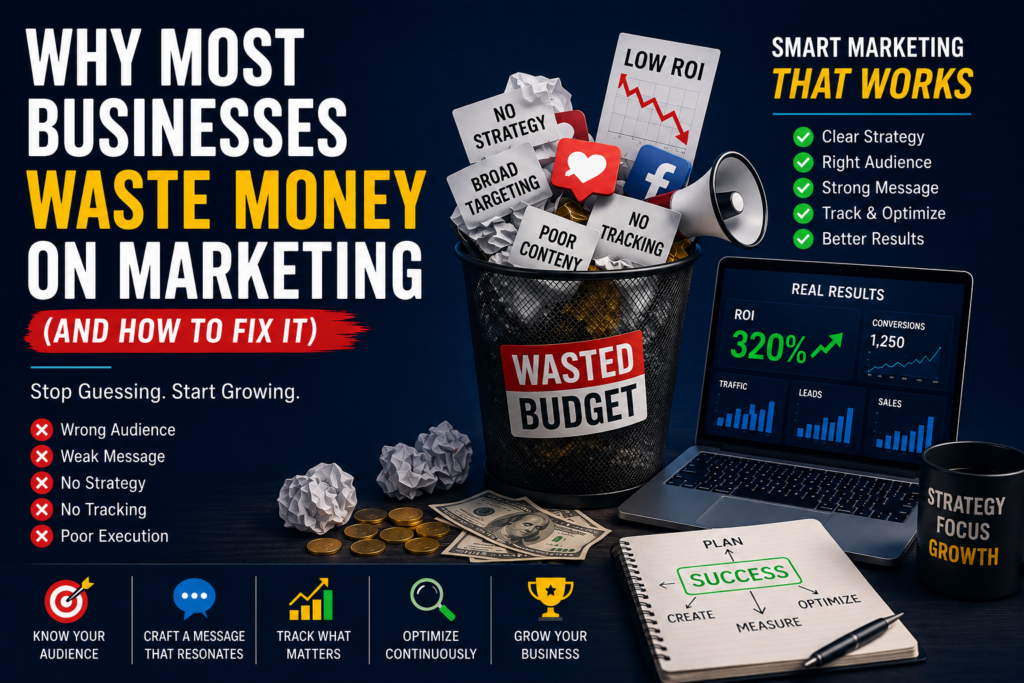
Every year, businesses invest thousands—sometimes millions—of dollars into marketing campaigns with the expectation of generating more leads, sales, and growth.
Yet many of those campaigns fail.
Not because marketing doesn’t work, but because businesses often focus on tactics before strategy.
They launch ads without understanding their audience. They post on social media without a content plan. They spend money driving traffic to websites that aren’t designed to convert visitors into customers.
The result? More spending, disappointing results, and the mistaken belief that marketing is the problem.
The Real Problem Isn’t Marketing
When business owners say, “We’ve tried marketing before, and it didn’t work,” the issue is rarely the marketing channel itself.
The problem is usually one of three things:
- The wrong audience
- The wrong message
- The wrong offer
Even the best advertising campaign cannot save a business that doesn’t clearly communicate its value or target the right people.
Before investing in any marketing activity, businesses need a clear understanding of who their ideal customers are, what challenges they face, and why they should choose one solution over another.
More Traffic Doesn’t Always Mean More Sales
One of the biggest misconceptions in marketing is that increasing website traffic automatically leads to business growth.
Traffic is only valuable if it converts.
A website receiving 1,000 visitors per month with a 10% conversion rate will often outperform a website receiving 10,000 visitors with a 0.5% conversion rate.
This is why successful businesses focus on the entire customer journey, not just attracting clicks.
Every landing page, call-to-action, form, and customer touchpoint should be designed to guide visitors toward a specific action.
The Cost of Inconsistent Branding
Many businesses treat marketing as a collection of isolated activities.
One week they’re running Facebook ads. The next week they’re redesigning their website. Then they start posting on LinkedIn.
Without a consistent brand message, customers become confused.
Strong brands communicate the same core message across every platform. Their website, social media content, advertising, and customer communications all reinforce the same value proposition.
Consistency builds trust. Trust drives conversions.
Why Data Should Guide Every Decision
Marketing should never be based solely on assumptions.
Today, businesses have access to more customer data than ever before. Website analytics, advertising platforms, CRM systems, and customer feedback provide valuable insights into what is working and what is not.
Businesses that regularly review and optimize their campaigns often achieve significantly better results than those that set campaigns live and forget about them.
The most successful marketers test, measure, learn, and improve continuously.
The Importance of Long-Term Thinking
Many businesses expect immediate results from every marketing effort.
While paid advertising can generate quick wins, sustainable growth usually comes from long-term strategies such as SEO, content marketing, email marketing, and brand building.
These channels require patience, but they create assets that continue delivering value long after the initial investment.
A well-ranked blog article, a strong email list, or a trusted brand reputation can generate leads for years.
Marketing Is an Investment, Not an Expense
The businesses that achieve the best results don’t view marketing as a cost.
They view it as an investment in future growth.
Every campaign, piece of content, customer interaction, and brand-building activity contributes to a larger system designed to attract, convert, and retain customers.
When marketing is approached strategically rather than reactively, it becomes one of the most powerful growth drivers available to any business.
Final Thoughts
The difference between successful marketing and wasted marketing spend often comes down to strategy.
Businesses that understand their audience, communicate a clear message, track performance, and commit to long-term growth are far more likely to see meaningful results.
The goal isn’t to spend more on marketing.
The goal is to market smarter.